Personalized Trip Concierge
Outcome
Turn a traveller's loose idea into a bookable, personalized itinerary by combining live inventory, rates, loyalty status, stated preferences, and destination knowledge, with explicit traveller confirmation before any booking is ticketed.
| Portfolio attribute | Value |
|---|---|
| Primary persona | Traveler |
| Primary aggregate | TripPlan |
| Cosmos DB containers | 2 |
| Grounding data | CRS and booking records, GDS/NDC offers, PMS inventory, loyalty entitlements, consented traveler preferences, destination guidance, partner inventory, pricing and hold events |
| Development estimate | USD 60-220 monthly dev estimate |
| Runtime options | Python FastAPI and C# ASP.NET Core |
Productivity hypothesis
These measures reflect the workflow, evidence, decision boundary, and industry risk for this use case.
| Impact type | Measure | Conservative internal assumption | Customer measurement |
|---|---|---|---|
| Productivity | Request-to-bookable-shortlist time | 10-20% reduction | (baseline median request-to-shortlist minutes - assisted median minutes) / baseline median minutes * 100 |
| Quality or risk | Price and change catch accuracy | 5-10 percentage-point improvement | assisted percentage of material price or itinerary changes caught before confirmation - baseline percentage |
| Business outcome | Offer-to-book conversion | 3-8% relative improvement | (assisted bookings per eligible shortlist - baseline rate) / baseline rate * 100 |
Important: Conservative internal pilot assumptions only; not public benchmarks, commitments, or expected customer results. Validate against a comparable baseline or matched control cohort with mandatory human review.
Rationale: Grounded itinerary discovery can shorten shortlist preparation and modestly improve conversion among comparable qualified requests.
Pilot guardrail: Travelers confirm suppliers, availability, prices, and terms before booking or ticketing.
Customer validation plan
- Baseline the current workflow with representative users and tasks.
- Run the accelerator on the same task mix with human review retained.
- Measure request-to-bookable-shortlist time and price and change catch accuracy with the documented formulas.
- Replace internal assumptions with customer-observed results before a business case.
Why Azure Cosmos DB
This AI solution needs an operational data plane, not only a vector index:
- Hybrid vector and full-text retrieval combines semantic recall with exact identifiers, codes, names, and domain language.
- Hierarchical partition keys and metadata predicates keep tenant and domain boundaries in the normal query path.
- Operational JSON, source chunks, workflow and agent state, feedback, and audit records remain together for low-latency reads and governed writes.
- Change feed reacts to source and operational updates without polling.
- Autoscale throughput, configurable consistency, and multi-region distribution support variable demand and enterprise availability.
Domain workflow
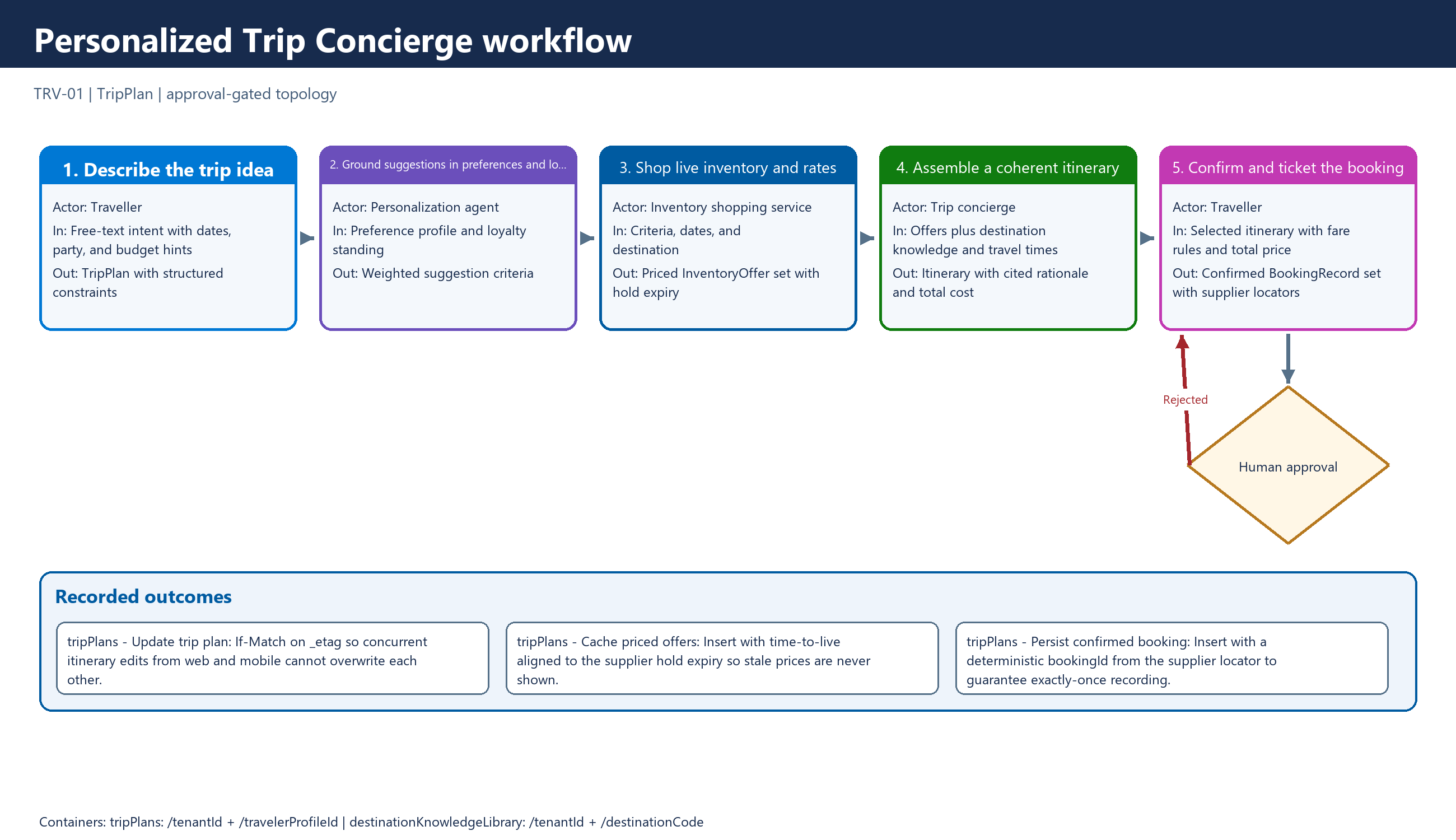
| Stage | Actor | Input → output | Approval |
|---|---|---|---|
| 1. Describe the trip idea | Traveller | Free-text intent with dates, party, and budget hints → TripPlan with structured constraints | Policy controlled |
| 2. Ground suggestions in preferences and loyalty | Personalization agent | Preference profile and loyalty standing → Weighted suggestion criteria | Policy controlled |
| 3. Shop live inventory and rates | Inventory shopping service | Criteria, dates, and destination → Priced InventoryOffer set with hold expiry | Policy controlled |
| 4. Assemble a coherent itinerary | Trip concierge | Offers plus destination knowledge and travel times → Itinerary with cited rationale and total cost | Policy controlled |
| 5. Confirm and ticket the booking | Traveller | Selected itinerary with fare rules and total price → Confirmed BookingRecord set with supplier locators | Human required |
Technical architecture
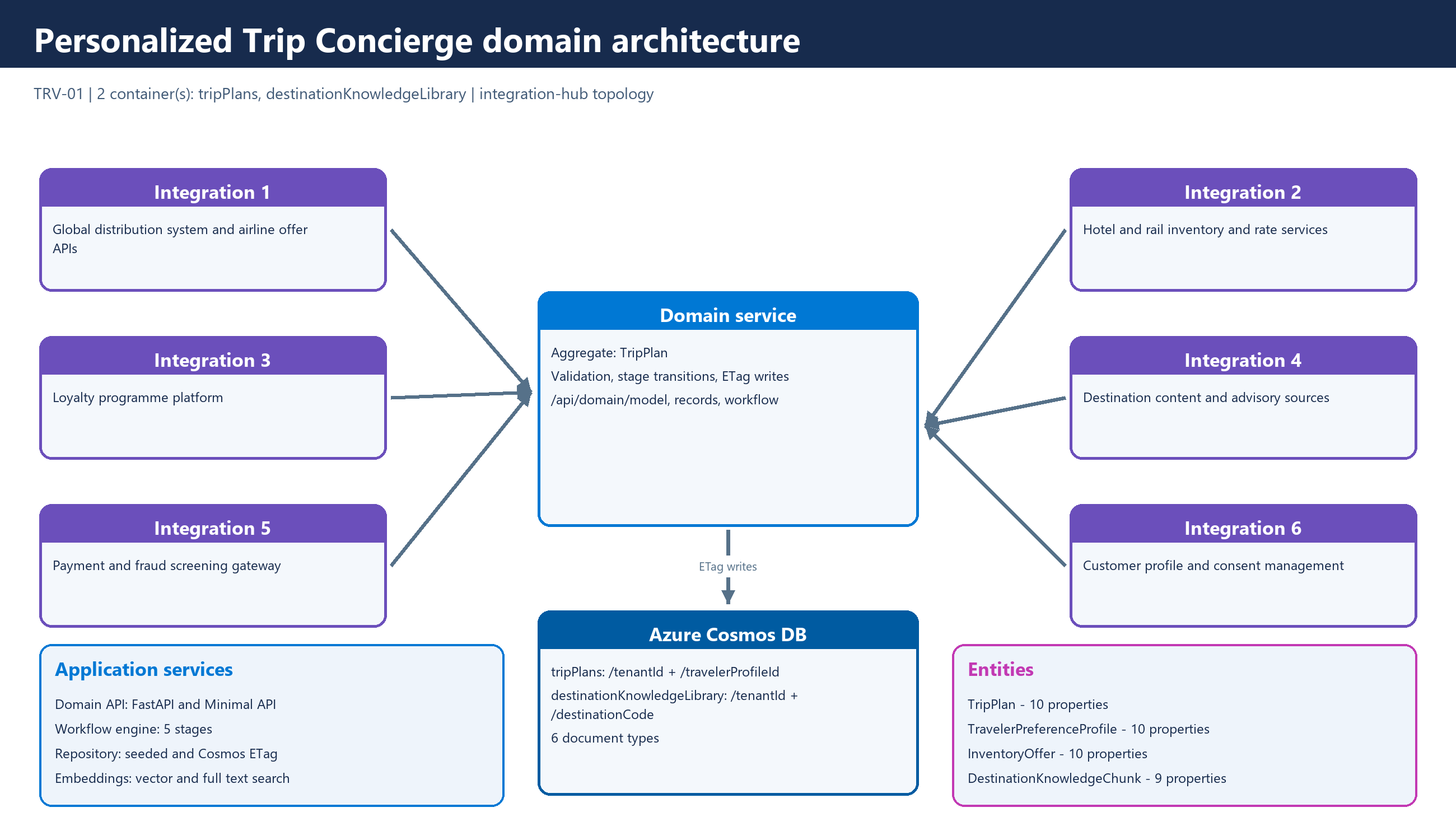
Cosmos DB data model
| Container | Hierarchical partition key | Documents | Search paths |
|---|---|---|---|
tripPlans | /tenantId, /travelerProfileId | TripPlan, TravelerPreferenceProfile, InventoryOffer, LoyaltyStandingSnapshot, BookingRecord | /tripIntentVectorEmbedding, /preferenceVectorEmbedding, /tripIntentVector, /preferenceVector |
destinationKnowledgeLibrary | /tenantId, /destinationCode | DestinationKnowledgeChunk | /bodyVectorEmbedding, /bodyVector |
Query contract
| Query | Container | Scope | Purpose |
|---|---|---|---|
| Trip planning context | tripPlans | single-partition | Read the trip, preferences, and loyalty standing for the traveller in one partition query. |
| Live offer shortlist | tripPlans | single-partition | Return only offers that are still held and inside the budget envelope. |
| Destination guidance retrieval | destinationKnowledgeLibrary | single-partition | Knowledge-container query against destinationKnowledgeLibrary (partition-aligned to /tenantId + /destinationCode): retrieve seasonality, visa, and neighbourhood guidance for the destination, read as a single partition query on the destination. |
| Upcoming confirmed bookings | tripPlans | single-partition | Show the traveller's confirmed reservations in departure order. |
Python and C# services route each document type to its declared container and hierarchical partition key. ETag-based writes protect mutable aggregates, while append-only records and bounded cross-partition queries preserve scale.
Azure deployment
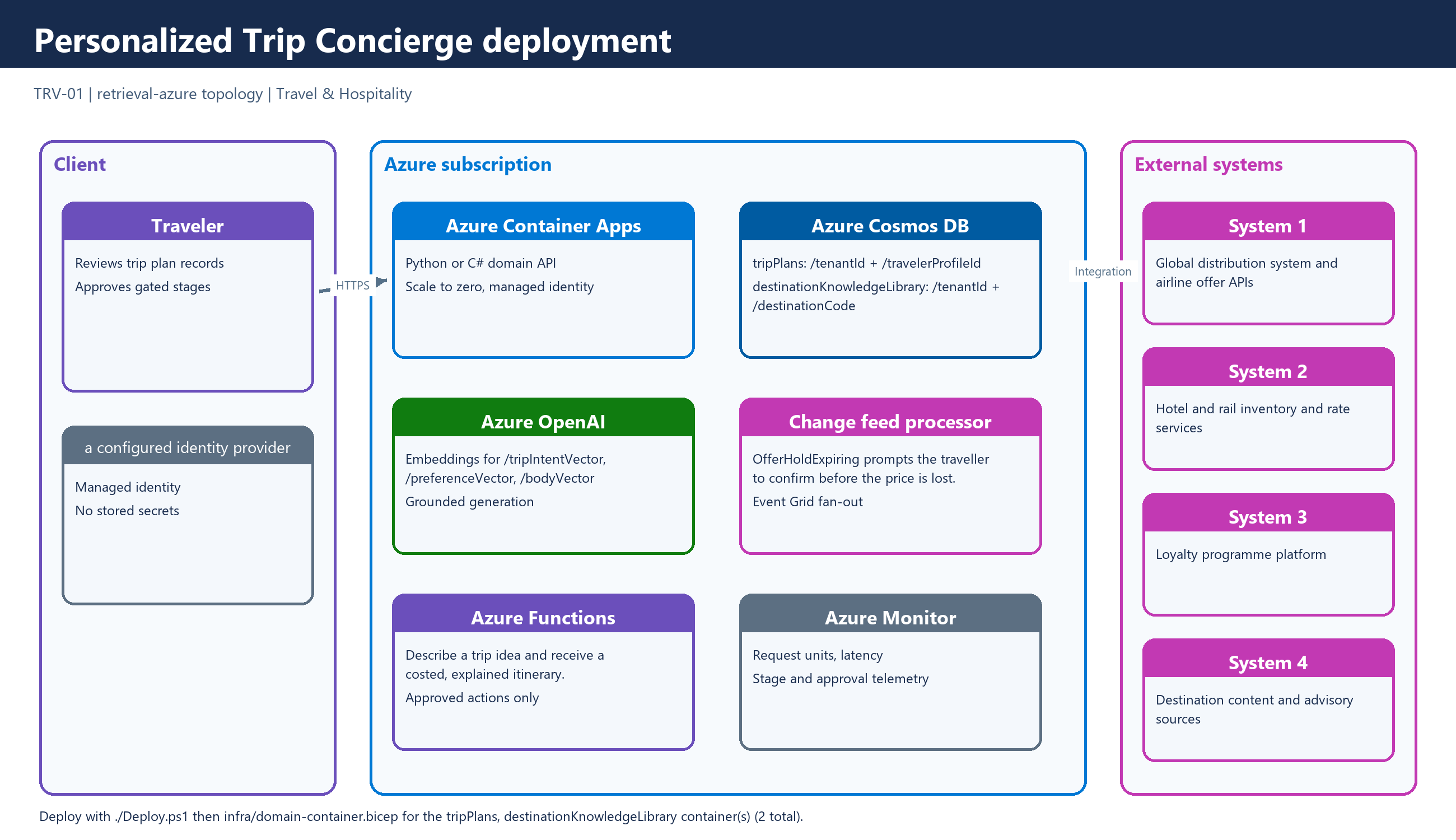
Clone the source repository, authenticate with Azure, and run:
Set-Location accelerators/travel-hospitality/personalized-trip-concierge
az login
./Deploy.ps1 -Runtime python -Location eastus2
Change python to csharp to deploy the .NET implementation.
Explore the implementation
- Launch signed-in demo
- Implementation article
- Domain data model
- Workflow and API contract
- Python application
- C# application
- Domain container Bicep
- Platform Bicep
- Cost and configuration
- Source repository