Subscriber Care Agent Assist
Outcome
Let a contact-centre agent resolve a subscriber's billing, device, or coverage issue on the first call by grounding answers in the live account, plan terms, device guides, and known outages, with agent confirmation before any account change.
| Portfolio attribute | Value |
|---|---|
| Primary persona | Contact-center agent |
| Primary aggregate | SubscriberContact |
| Cosmos DB containers | 3 |
| Grounding data | CRM, plans, bills, device guides, outages |
| Development estimate | USD 60-220 monthly dev estimate |
| Runtime options | Python FastAPI and C# ASP.NET Core |
Productivity hypothesis
These measures reflect the workflow, evidence, decision boundary, and industry risk for this use case.
| Impact type | Measure | Conservative internal assumption | Customer measurement |
|---|---|---|---|
| Productivity | Contact-to-approved-resolution time | 15-25% reduction | (baseline median contact-to-resolution minutes - assisted median minutes) / baseline median minutes * 100 |
| Quality or risk | Accepted responses | 5-10 percentage-point improvement | assisted percentage of responses accepted without material rework - baseline percentage |
Important: Conservative internal pilot assumptions only; not public benchmarks, commitments, or expected customer results. Validate against a comparable baseline or matched control cohort with mandatory human review.
Rationale: CRM, plans, bills, device guides, and outage data support faster grounded subscriber-care responses.
Pilot guardrail: Authorized staff approve billing, account, plan, device, and service commitments.
Customer validation plan
- Baseline the current workflow with representative users and tasks.
- Run the accelerator on the same task mix with human review retained.
- Measure contact-to-approved-resolution time and accepted responses with the documented formulas.
- Replace internal assumptions with customer-observed results before a business case.
Why Azure Cosmos DB
This AI solution needs an operational data plane, not only a vector index:
- Hybrid vector and full-text retrieval combines semantic recall with exact identifiers, codes, names, and domain language.
- Hierarchical partition keys and metadata predicates keep tenant and domain boundaries in the normal query path.
- Operational JSON, source chunks, workflow and agent state, feedback, and audit records remain together for low-latency reads and governed writes.
- Change feed reacts to source and operational updates without polling.
- Autoscale throughput, configurable consistency, and multi-region distribution support variable demand and enterprise availability.
Domain workflow
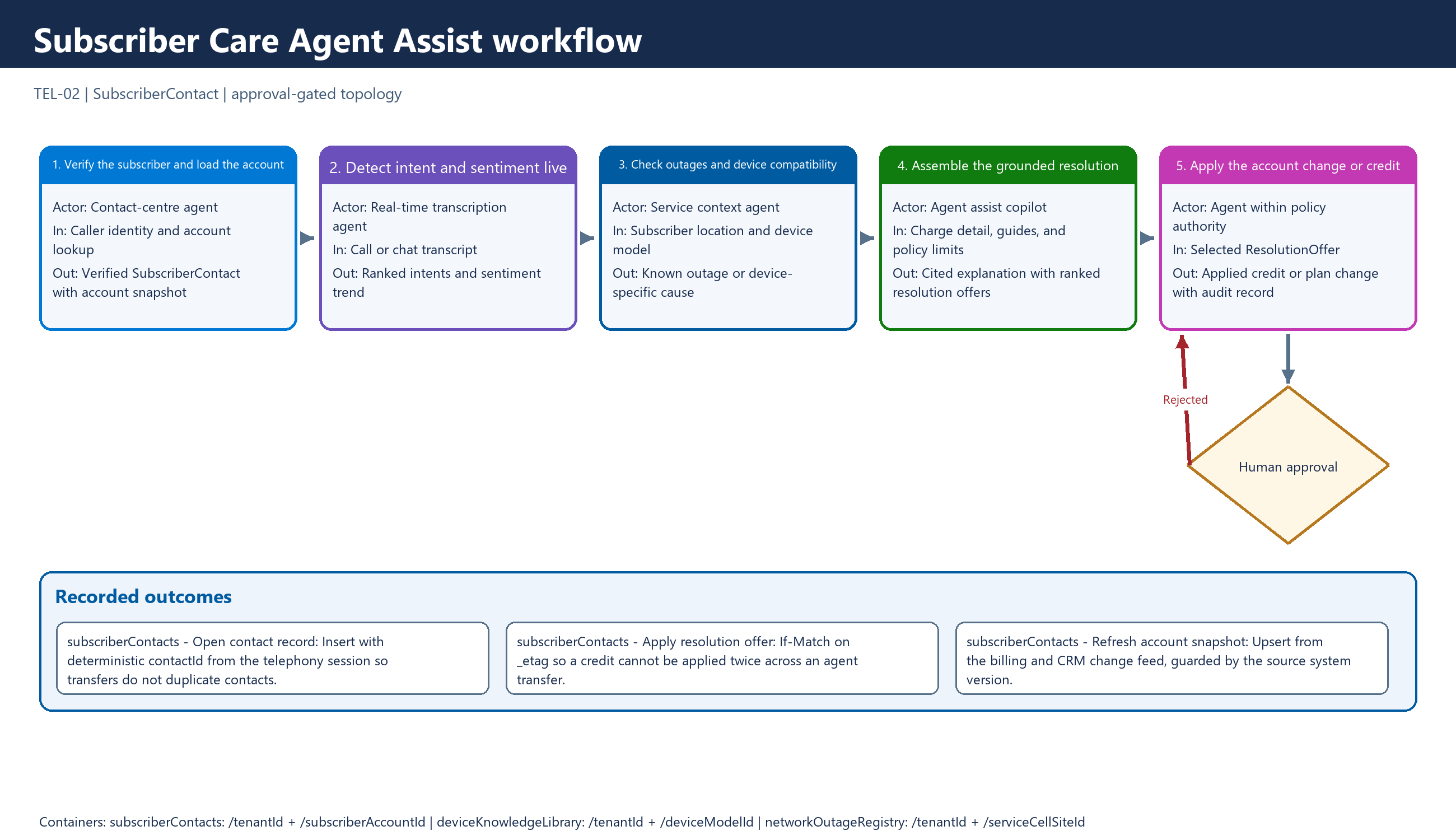
| Stage | Actor | Input → output | Approval |
|---|---|---|---|
| 1. Verify the subscriber and load the account | Contact-centre agent | Caller identity and account lookup → Verified SubscriberContact with account snapshot | Policy controlled |
| 2. Detect intent and sentiment live | Real-time transcription agent | Call or chat transcript → Ranked intents and sentiment trend | Policy controlled |
| 3. Check outages and device compatibility | Service context agent | Subscriber location and device model → Known outage or device-specific cause | Policy controlled |
| 4. Assemble the grounded resolution | Agent assist copilot | Charge detail, guides, and policy limits → Cited explanation with ranked resolution offers | Policy controlled |
| 5. Apply the account change or credit | Agent within policy authority | Selected ResolutionOffer → Applied credit or plan change with audit record | Human required |
Technical architecture
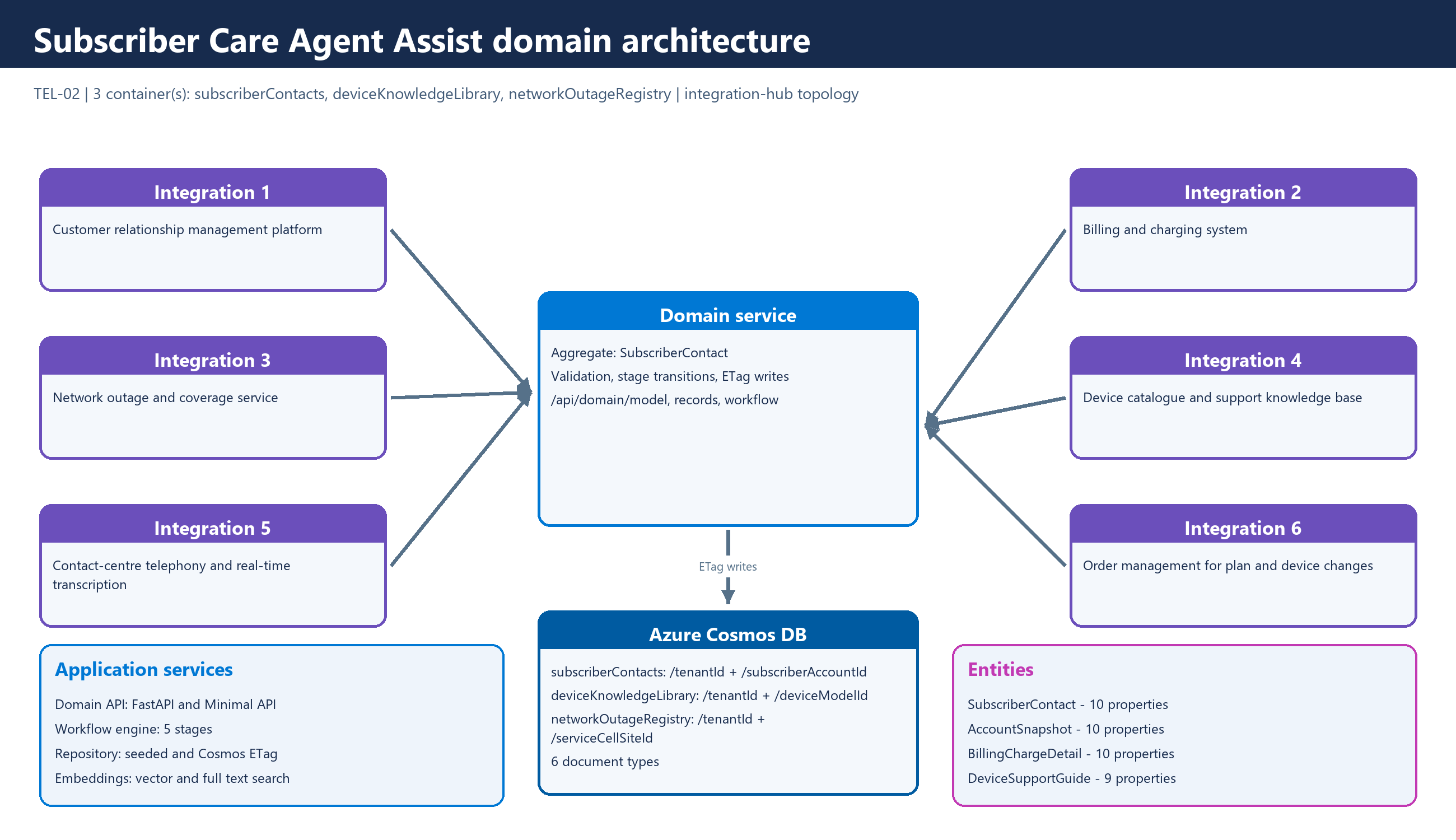
Cosmos DB data model
| Container | Hierarchical partition key | Documents | Search paths |
|---|---|---|---|
subscriberContacts | /tenantId, /subscriberAccountId | SubscriberContact, AccountSnapshot, BillingChargeDetail, ResolutionOffer | Operational fields only |
deviceKnowledgeLibrary | /tenantId, /deviceModelId | DeviceSupportGuide | /bodyVectorEmbedding, /bodyVector |
networkOutageRegistry | /tenantId, /serviceCellSiteId | NetworkOutageNotice | Operational fields only |
Query contract
| Query | Container | Scope | Purpose |
|---|---|---|---|
| Account 360 load | subscriberContacts | single-partition | Read the account snapshot, recent charges, and open offers in one partition query. |
| Disputed charge isolation | subscriberContacts | single-partition | Pinpoint the charges on the disputed invoice that changed versus the prior cycle. |
| Active outage at the subscriber location | networkOutageRegistry | single-partition | Knowledge-container query against networkOutageRegistry (partition-aligned to /tenantId + /serviceCellSiteId): confirm whether a known network issue explains the reported symptom; the registry fans an outage out to one document per affected cell site so the subscriber lookup is a single partition read. |
| Device and firmware guide retrieval | deviceKnowledgeLibrary | single-partition | Knowledge-container query against deviceKnowledgeLibrary (partition-aligned to /tenantId + /deviceModelId): return troubleshooting steps valid for the subscriber's device model and OS version, read as a single partition query on the device model. |
Python and C# services route each document type to its declared container and hierarchical partition key. ETag-based writes protect mutable aggregates, while append-only records and bounded cross-partition queries preserve scale.
Azure deployment
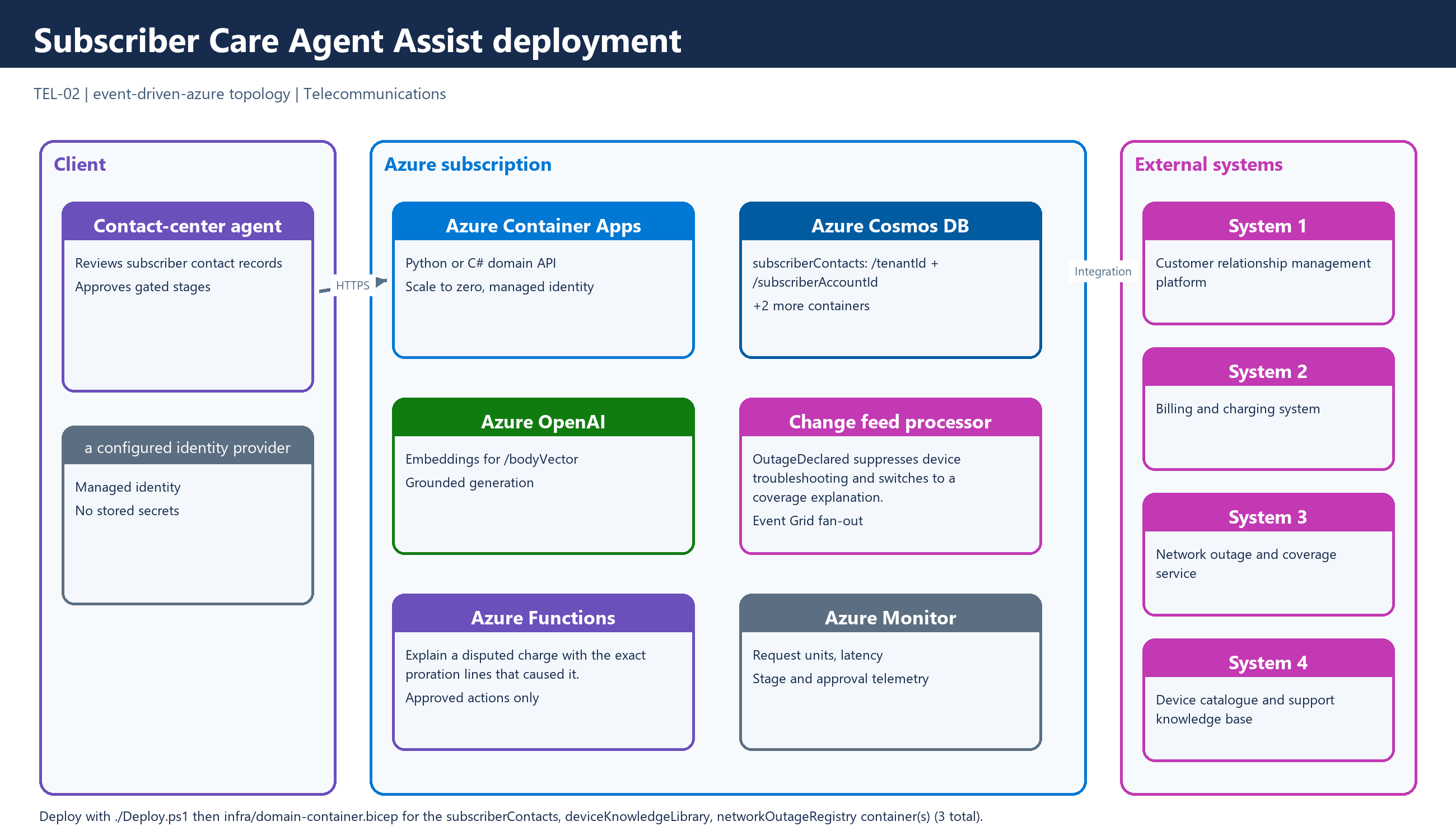
Clone the source repository, authenticate with Azure, and run:
Set-Location accelerators/telecommunications/subscriber-care-agent-assist
az login
./Deploy.ps1 -Runtime python -Location eastus2
Change python to csharp to deploy the .NET implementation.
Explore the implementation
- Launch signed-in demo
- Implementation article
- Domain data model
- Workflow and API contract
- Python application
- C# application
- Domain container Bicep
- Platform Bicep
- Cost and configuration
- Source repository