Scientific Literature Intelligence
Outcome
Let research scientists move from a biological question to a defensible evidence synthesis across papers, patents, protocols, and internal study reports, with a scientist reviewing provenance before conclusions are circulated.
| Portfolio attribute | Value |
|---|---|
| Primary persona | Research scientist |
| Primary aggregate | ResearchQuestion |
| Cosmos DB containers | 2 |
| Grounding data | papers, protocols, studies, patents |
| Development estimate | USD 60-220 monthly dev estimate |
| Runtime options | Python FastAPI and C# ASP.NET Core |
Productivity hypothesis
These measures reflect the workflow, evidence, decision boundary, and industry risk for this use case.
| Impact type | Measure | Conservative internal assumption | Customer measurement |
|---|---|---|---|
| Productivity | Literature discovery time | 20-40% reduction | (baseline median literature-search minutes - assisted median minutes) / baseline median minutes * 100 |
| Quality or risk | First-pass acceptance | 8-15 percentage-point improvement | assisted percentage accepted without material rework - baseline percentage accepted without material rework |
Important: Conservative internal pilot assumptions only; not public benchmarks, commitments, or expected customer results. Validate against a comparable baseline or matched control cohort with mandatory human review.
Rationale: Research scientists can accelerate broad literature triangulation, while scientific interpretation remains expert-reviewed.
Pilot guardrail: Keep every conclusion within the cited papers, protocols, studies, and patents.
Customer validation plan
- Baseline the current workflow with representative users and tasks.
- Run the accelerator on the same task mix with human review retained.
- Measure literature discovery time and first-pass acceptance with the documented formulas.
- Replace internal assumptions with customer-observed results before a business case.
Why Azure Cosmos DB
This AI solution needs an operational data plane, not only a vector index:
- Hybrid vector and full-text retrieval combines semantic recall with exact identifiers, codes, names, and domain language.
- Hierarchical partition keys and metadata predicates keep tenant and domain boundaries in the normal query path.
- Operational JSON, source chunks, workflow and agent state, feedback, and audit records remain together for low-latency reads and governed writes.
- Change feed reacts to source and operational updates without polling.
- Autoscale throughput, configurable consistency, and multi-region distribution support variable demand and enterprise availability.
Domain workflow
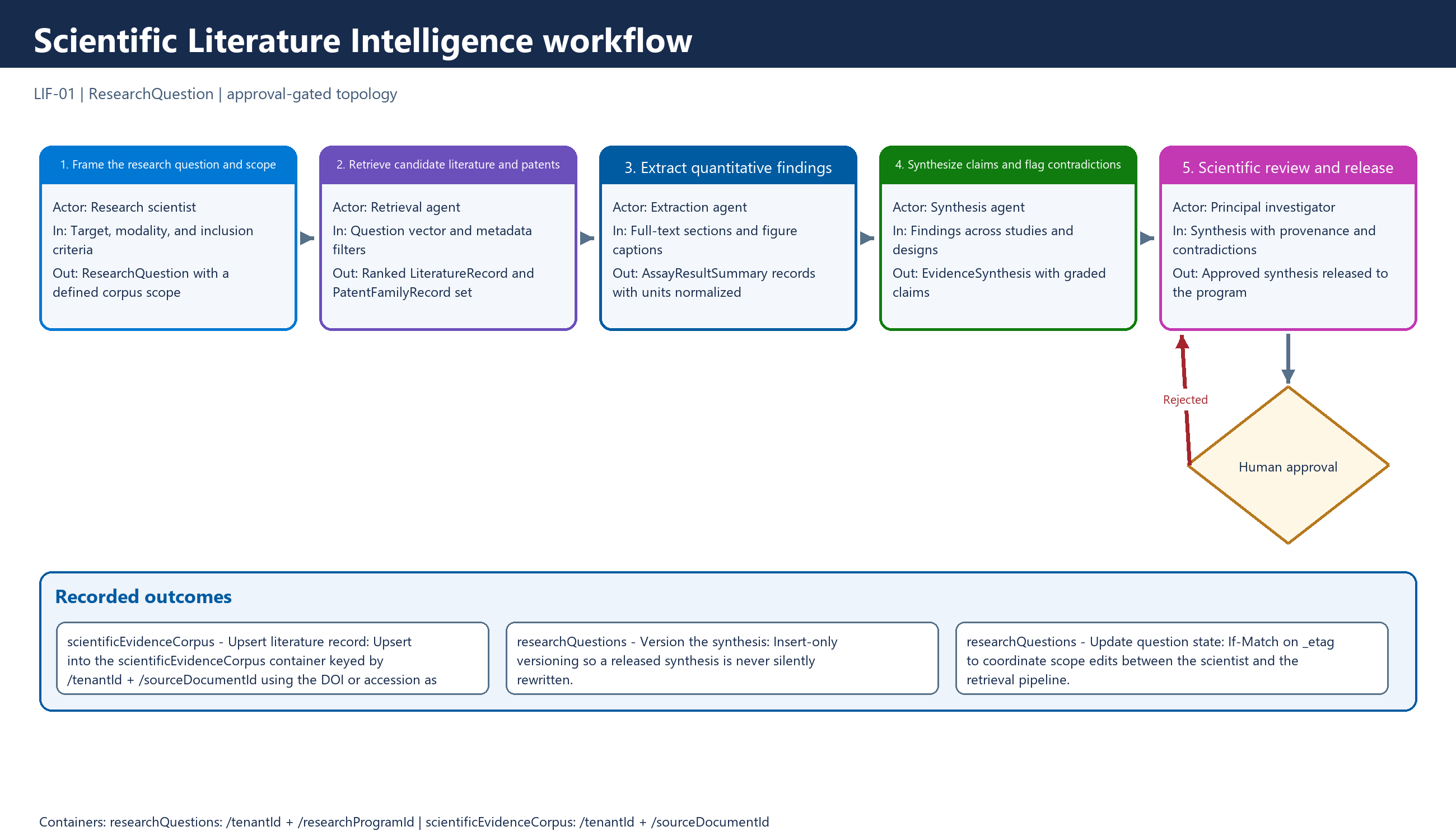
| Stage | Actor | Input → output | Approval |
|---|---|---|---|
| 1. Frame the research question and scope | Research scientist | Target, modality, and inclusion criteria → ResearchQuestion with a defined corpus scope | Policy controlled |
| 2. Retrieve candidate literature and patents | Retrieval agent | Question vector and metadata filters → Ranked LiteratureRecord and PatentFamilyRecord set | Policy controlled |
| 3. Extract quantitative findings | Extraction agent | Full-text sections and figure captions → AssayResultSummary records with units normalized | Policy controlled |
| 4. Synthesize claims and flag contradictions | Synthesis agent | Findings across studies and designs → EvidenceSynthesis with graded claims | Policy controlled |
| 5. Scientific review and release | Principal investigator | Synthesis with provenance and contradictions → Approved synthesis released to the program | Human required |
Technical architecture
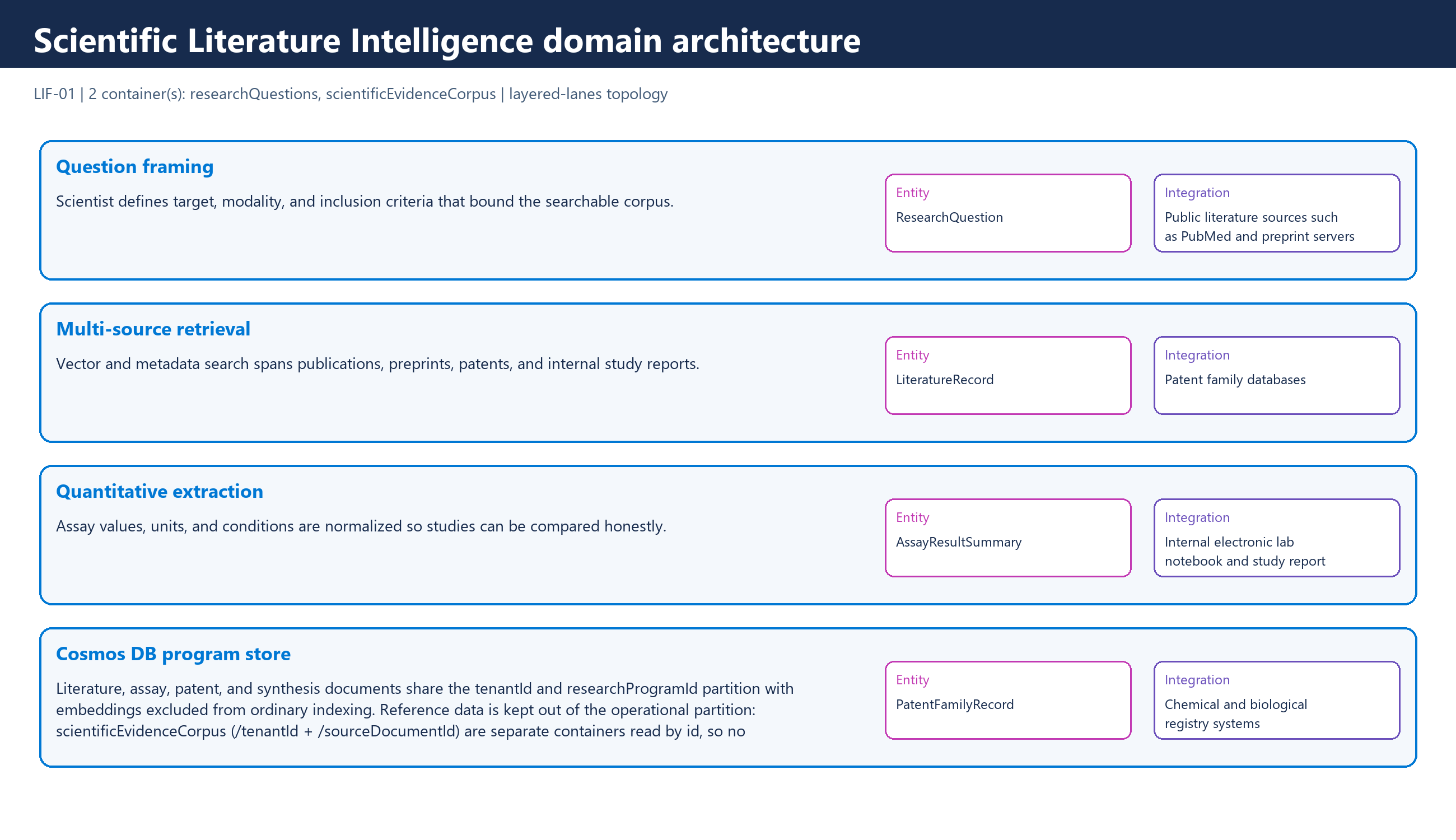
Cosmos DB data model
| Container | Hierarchical partition key | Documents | Search paths |
|---|---|---|---|
researchQuestions | /tenantId, /researchProgramId | ResearchQuestion, EvidenceSynthesis | /questionVectorEmbedding, /synthesisVectorEmbedding, /questionVector, /synthesisVector |
scientificEvidenceCorpus | /tenantId, /sourceDocumentId | LiteratureRecord, AssayResultSummary, PatentFamilyRecord | /abstractVectorEmbedding, /titleVectorEmbedding, /claimScopeVectorEmbedding, /abstractVector, /titleVector, /claimScopeVector |
Query contract
| Query | Container | Scope | Purpose |
|---|---|---|---|
| Target evidence roll-up | scientificEvidenceCorpus | cross-partition-bounded | Knowledge-container query against scientificEvidenceCorpus (bounded fan-out across the /tenantId + /sourceDocumentId partitions named by the shortlist): gather the literature and assay evidence cited for the target, fanned out across the source document ids the programme's synthesis references. |
| Potency threshold screen | scientificEvidenceCorpus | cross-partition-bounded | Knowledge-container query against scientificEvidenceCorpus (bounded fan-out across the /tenantId + /sourceDocumentId partitions named by the shortlist): screen extracted assay results against the potency threshold, over the bounded set of source documents retrieved for the question. |
| Freedom-to-operate watch | scientificEvidenceCorpus | cross-partition-bounded | Knowledge-container query against scientificEvidenceCorpus (bounded fan-out across the /tenantId + /sourceDocumentId partitions named by the shortlist): surface live patent families with priority dates relevant to the programme's chemical space, over the patent family ids returned by the structure and claim search. |
| Contradiction review queue | researchQuestions | single-partition | List syntheses for this programme whose claims conflict across studies and need scientist adjudication. |
Python and C# services route each document type to its declared container and hierarchical partition key. ETag-based writes protect mutable aggregates, while append-only records and bounded cross-partition queries preserve scale.
Azure deployment
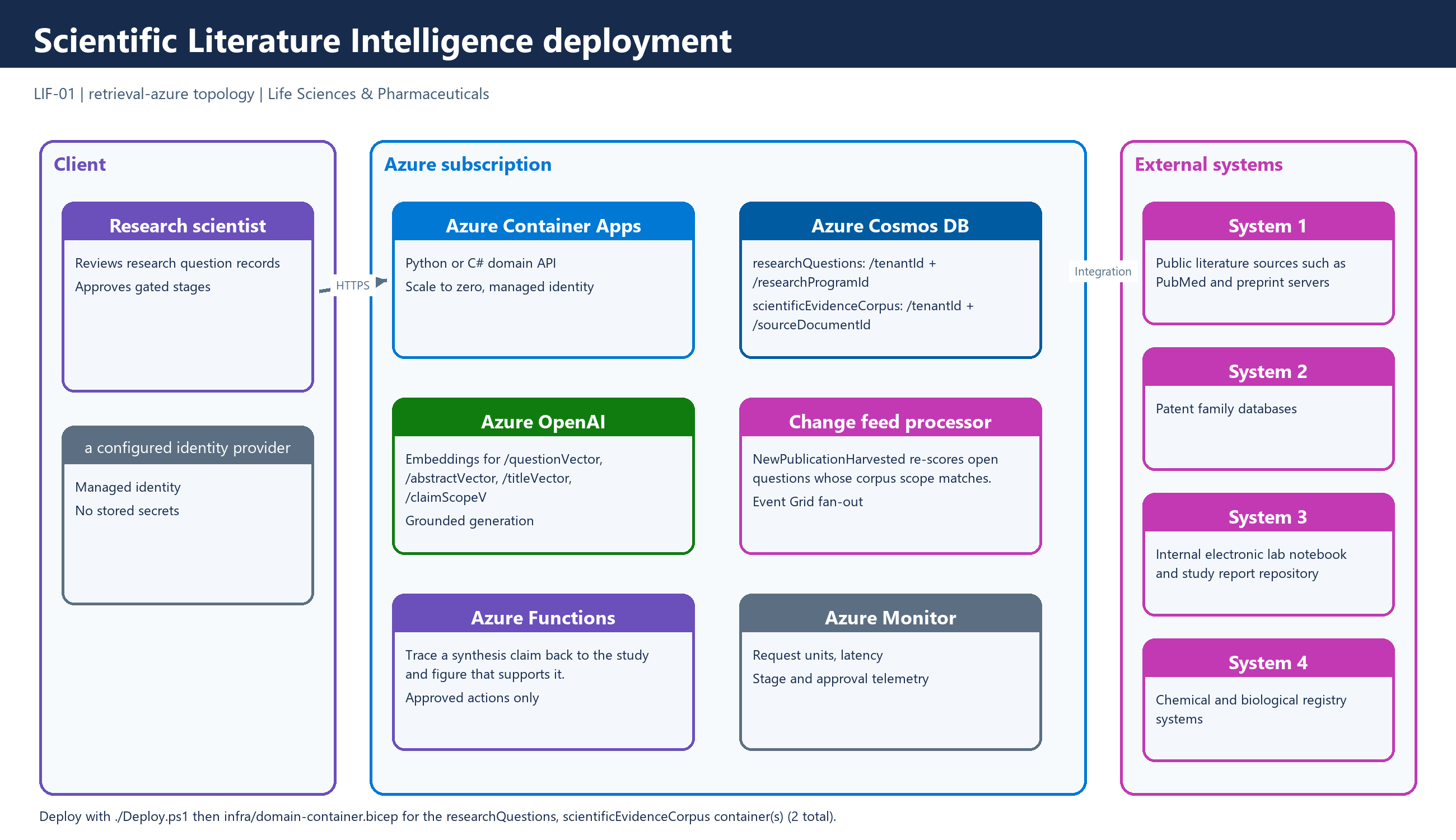
Clone the source repository, authenticate with Azure, and run:
Set-Location accelerators/life-sciences-pharmaceuticals/scientific-literature-intelligence
az login
./Deploy.ps1 -Runtime python -Location eastus2
Change python to csharp to deploy the .NET implementation.
Explore the implementation
- Launch signed-in demo
- Implementation article
- Domain data model
- Workflow and API contract
- Python application
- C# application
- Domain container Bicep
- Platform Bicep
- Cost and configuration
- Source repository