Underwriting Submission Workbench
Outcome
Turn unstructured broker submissions into a triaged, priced risk file by extracting exposures, normalizing loss runs, and testing appetite and guideline fit before an underwriter binds or declines.
| Portfolio attribute | Value |
|---|---|
| Primary persona | Underwriter |
| Primary aggregate | SubmissionFile |
| Cosmos DB containers | 2 |
| Grounding data | applications, loss runs, guidelines, risk data |
| Development estimate | USD 60-220 monthly dev estimate |
| Runtime options | Python FastAPI and C# ASP.NET Core |
Productivity hypothesis
These measures reflect the workflow, evidence, decision boundary, and industry risk for this use case.
| Impact type | Measure | Conservative internal assumption | Customer measurement |
|---|---|---|---|
| Productivity | Submission preparation time | 8-12% reduction | (baseline median submission-preparation minutes - assisted median minutes) / baseline median minutes * 100 |
| Quality or risk | Corrected or reopened packets | 3-6% reduction | (baseline corrected or reopened packet rate - assisted rate) / baseline rate * 100 |
Important: Conservative internal pilot assumptions only; not public benchmarks, commitments, or expected customer results. Validate against a comparable baseline or matched control cohort with mandatory human review.
Rationale: Applications, loss runs, guidelines, and risk data can be assembled faster without automating underwriting judgment.
Pilot guardrail: Underwriters retain risk selection, pricing, terms, and approval authority.
Customer validation plan
- Baseline the current workflow with representative users and tasks.
- Run the accelerator on the same task mix with human review retained.
- Measure submission preparation time and corrected or reopened packets with the documented formulas.
- Replace internal assumptions with customer-observed results before a business case.
Why Azure Cosmos DB
This AI solution needs an operational data plane, not only a vector index:
- Hybrid vector and full-text retrieval combines semantic recall with exact identifiers, codes, names, and domain language.
- Hierarchical partition keys and metadata predicates keep tenant and domain boundaries in the normal query path.
- Operational JSON, source chunks, workflow and agent state, feedback, and audit records remain together for low-latency reads and governed writes.
- Change feed reacts to source and operational updates without polling.
- Autoscale throughput, configurable consistency, and multi-region distribution support variable demand and enterprise availability.
Domain workflow
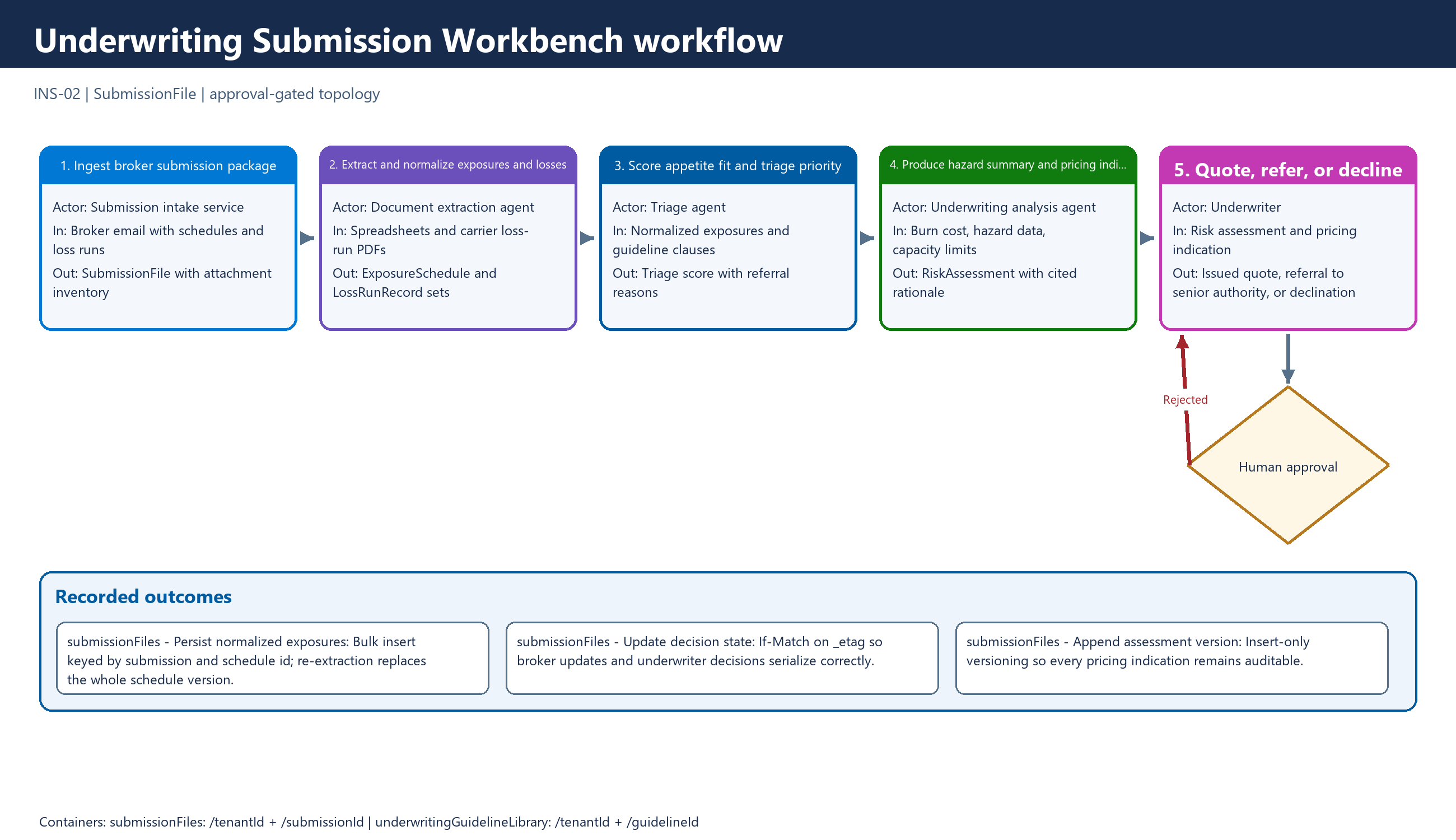
| Stage | Actor | Input → output | Approval |
|---|---|---|---|
| 1. Ingest broker submission package | Submission intake service | Broker email with schedules and loss runs → SubmissionFile with attachment inventory | Policy controlled |
| 2. Extract and normalize exposures and losses | Document extraction agent | Spreadsheets and carrier loss-run PDFs → ExposureSchedule and LossRunRecord sets | Policy controlled |
| 3. Score appetite fit and triage priority | Triage agent | Normalized exposures and guideline clauses → Triage score with referral reasons | Policy controlled |
| 4. Produce hazard summary and pricing indication | Underwriting analysis agent | Burn cost, hazard data, capacity limits → RiskAssessment with cited rationale | Policy controlled |
| 5. Quote, refer, or decline | Underwriter | Risk assessment and pricing indication → Issued quote, referral to senior authority, or declination | Human required |
Technical architecture
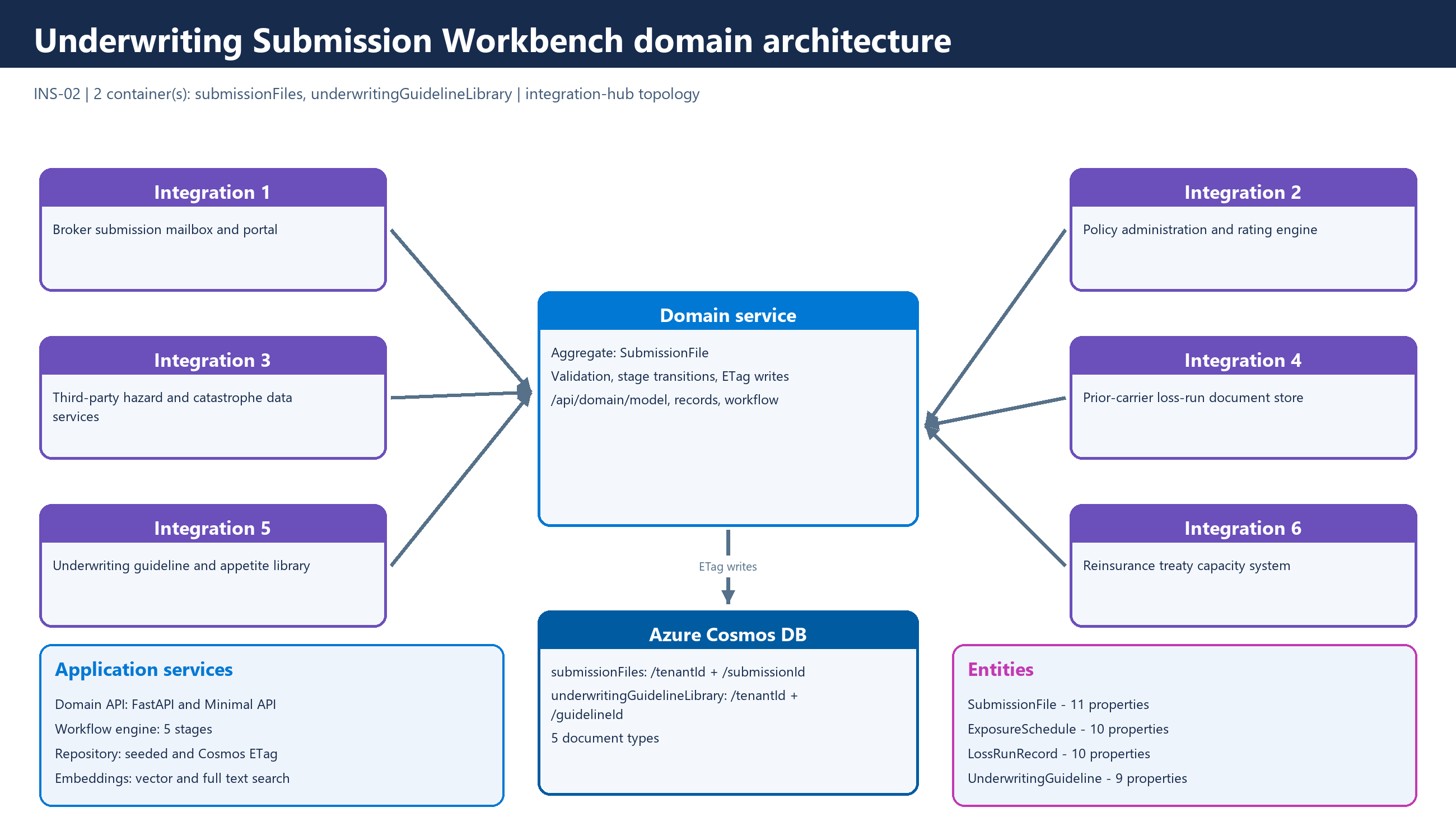
Cosmos DB data model
| Container | Hierarchical partition key | Documents | Search paths |
|---|---|---|---|
submissionFiles | /tenantId, /submissionId | SubmissionFile, ExposureSchedule, LossRunRecord, RiskAssessment | /hazardSummaryVectorEmbedding, /hazardSummaryVector |
underwritingGuidelineLibrary | /tenantId, /guidelineId | UnderwritingGuideline | /clauseVectorEmbedding, /clauseVector |
Query contract
| Query | Container | Scope | Purpose |
|---|---|---|---|
| Submission file assembly | submissionFiles | single-partition | Load schedules, loss runs, and the assessment for one submission in one partition read. |
| Bind-by-date work queue | submissionFiles | cross-partition-bounded | Bounded cross-partition control-plane query: prioritize undecided submissions by effective date and triage score. It cannot carry the second partition key because an underwriter's queue spans every submission assigned to them, so it runs as a tenant-scoped scheduled sweep off the interactive path, bounded by submissions in triage whose target effective date falls inside 30 days, executed with MaxItemCount paging and continuation tokens. |
| Adverse loss history scan | submissionFiles | single-partition | Identify submissions with large incurred losses in the recent policy years. |
| Low-confidence extraction review | submissionFiles | cross-partition-bounded | Bounded cross-partition control-plane query: route schedules whose extraction confidence is too low for automated pricing. It cannot carry the second partition key because the extraction quality queue is a pipeline-wide control surface, so it runs as a tenant-scoped scheduled sweep off the interactive path, bounded by schedules below the confidence floor on submissions still in triage, executed with MaxItemCount paging and continuation tokens. |
Python and C# services route each document type to its declared container and hierarchical partition key. ETag-based writes protect mutable aggregates, while append-only records and bounded cross-partition queries preserve scale.
Azure deployment
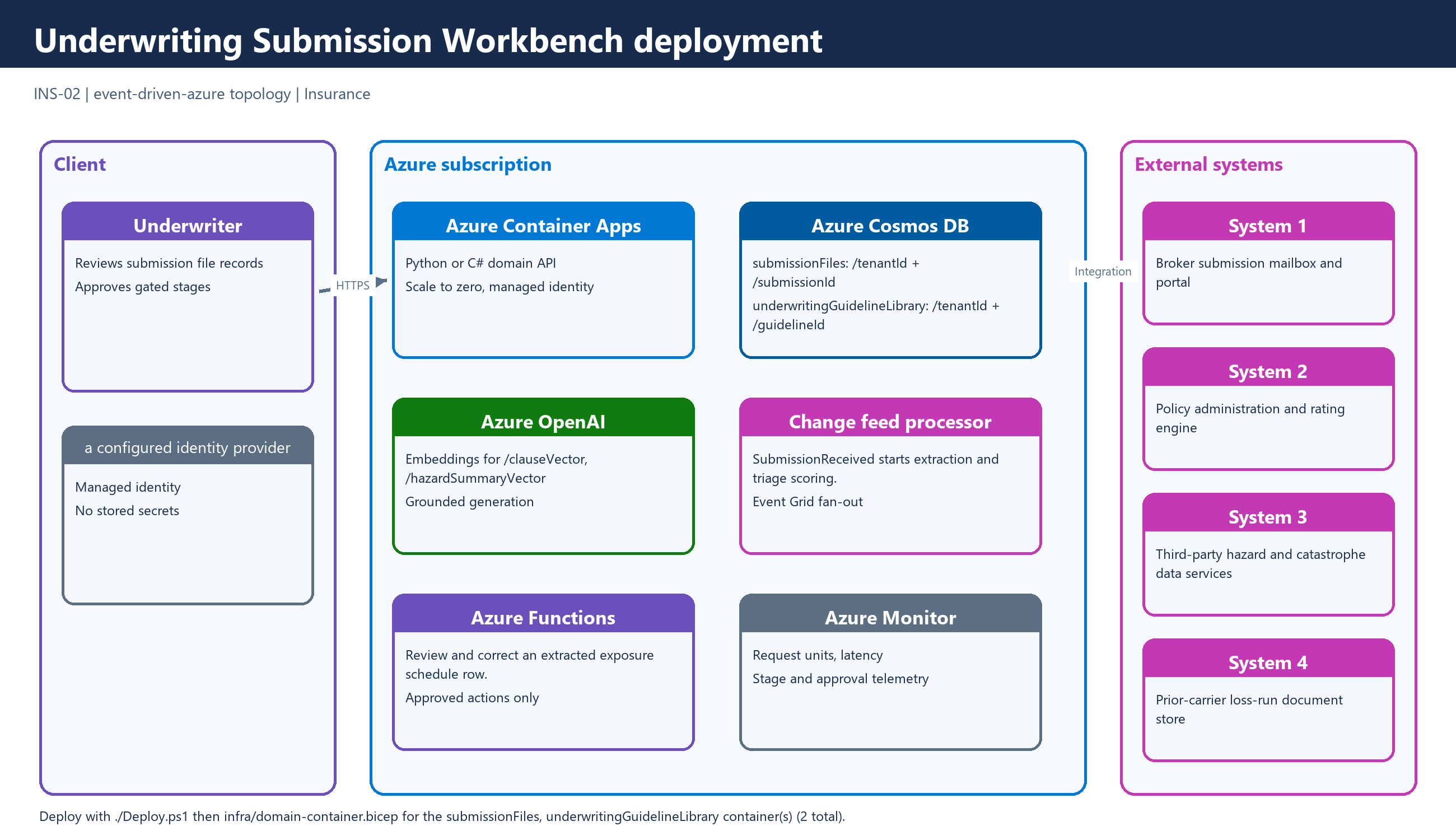
Clone the source repository, authenticate with Azure, and run:
Set-Location accelerators/insurance/underwriting-submission-workbench
az login
./Deploy.ps1 -Runtime python -Location eastus2
Change python to csharp to deploy the .NET implementation.
Explore the implementation
- Launch signed-in demo
- Implementation article
- Domain data model
- Workflow and API contract
- Python application
- C# application
- Domain container Bicep
- Platform Bicep
- Cost and configuration
- Source repository