Grid Event Intelligence
Outcome
Help control-room operators cut through alarm storms by correlating SCADA events with network topology, weather, and field work into a ranked probable-cause narrative, while every switching action stays an operator decision.
| Portfolio attribute | Value |
|---|---|
| Primary persona | Control-room operator |
| Primary aggregate | GridEvent |
| Cosmos DB containers | 1 |
| Grounding data | SCADA alerts, topology, weather, work logs |
| Development estimate | USD 60-220 monthly dev estimate |
| Runtime options | Python FastAPI and C# ASP.NET Core |
Productivity hypothesis
These measures reflect the workflow, evidence, decision boundary, and industry risk for this use case.
| Impact type | Measure | Conservative internal assumption | Customer measurement |
|---|---|---|---|
| Productivity | Event brief preparation time | 8-12% reduction | (baseline median brief-preparation minutes - assisted median minutes) / baseline median minutes * 100 |
| Quality or risk | Corrected or reissued briefs | 3-6% reduction | (baseline corrected or reissued brief rate - assisted rate) / baseline rate * 100 |
Important: Conservative internal pilot assumptions only; not public benchmarks, commitments, or expected customer results. Validate against a comparable baseline or matched control cohort with mandatory human review.
Rationale: Incident, topology, weather, and work-log evidence can accelerate situation synthesis without automating grid control.
Pilot guardrail: Operators retain authority for switching, warnings, escalation, and resource commitments.
Customer validation plan
- Baseline the current workflow with representative users and tasks.
- Run the accelerator on the same task mix with human review retained.
- Measure event brief preparation time and corrected or reissued briefs with the documented formulas.
- Replace internal assumptions with customer-observed results before a business case.
Why Azure Cosmos DB
This AI solution needs an operational data plane, not only a vector index:
- Hybrid vector and full-text retrieval combines semantic recall with exact identifiers, codes, names, and domain language.
- Hierarchical partition keys and metadata predicates keep tenant and domain boundaries in the normal query path.
- Operational JSON, source chunks, workflow and agent state, feedback, and audit records remain together for low-latency reads and governed writes.
- Change feed reacts to source and operational updates without polling.
- Autoscale throughput, configurable consistency, and multi-region distribution support variable demand and enterprise availability.
Domain workflow
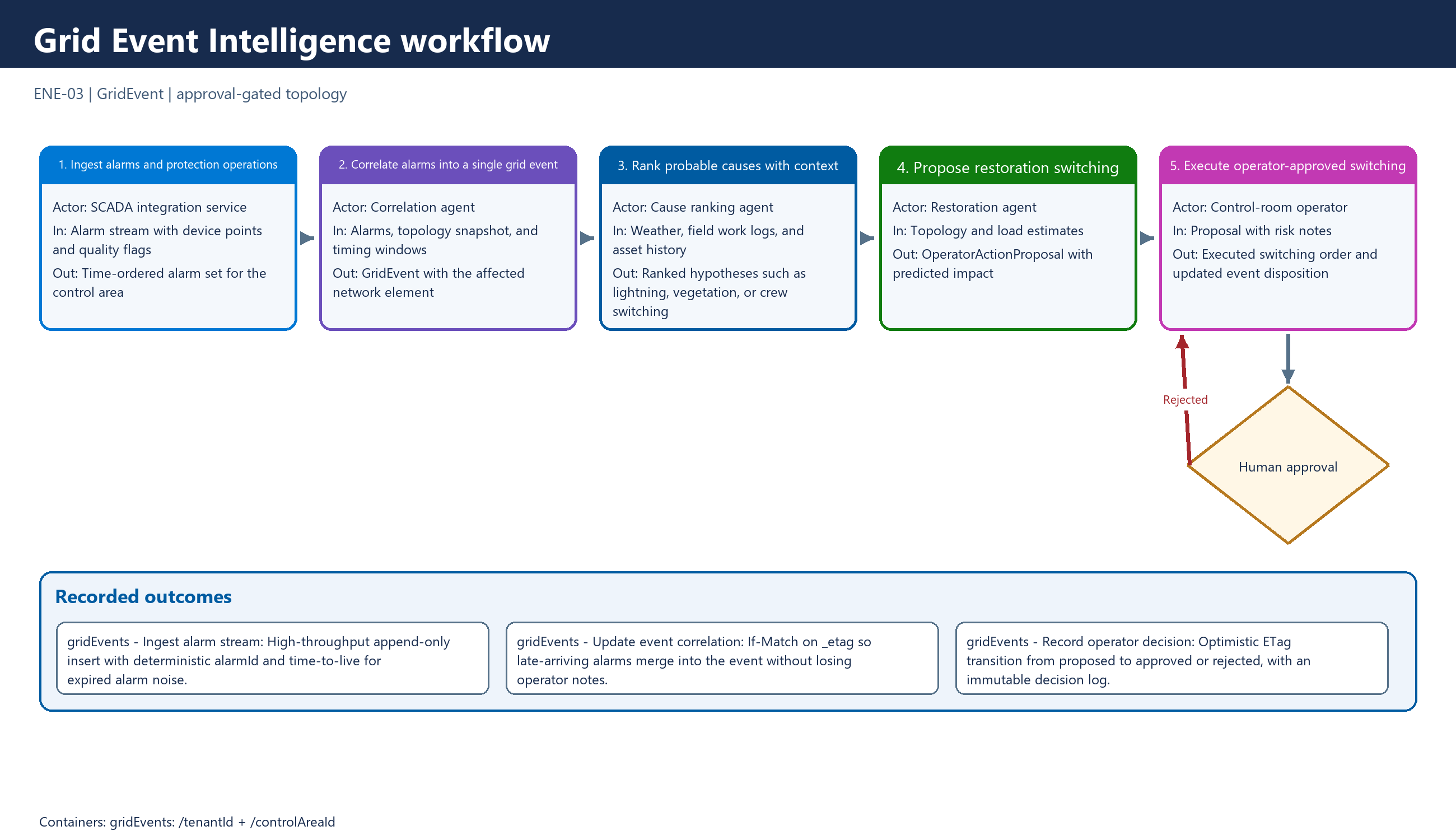
| Stage | Actor | Input → output | Approval |
|---|---|---|---|
| 1. Ingest alarms and protection operations | SCADA integration service | Alarm stream with device points and quality flags → Time-ordered alarm set for the control area | Policy controlled |
| 2. Correlate alarms into a single grid event | Correlation agent | Alarms, topology snapshot, and timing windows → GridEvent with the affected network element | Policy controlled |
| 3. Rank probable causes with context | Cause ranking agent | Weather, field work logs, and asset history → Ranked hypotheses such as lightning, vegetation, or crew switching | Policy controlled |
| 4. Propose restoration switching | Restoration agent | Topology and load estimates → OperatorActionProposal with predicted impact | Policy controlled |
| 5. Execute operator-approved switching | Control-room operator | Proposal with risk notes → Executed switching order and updated event disposition | Human required |
Technical architecture
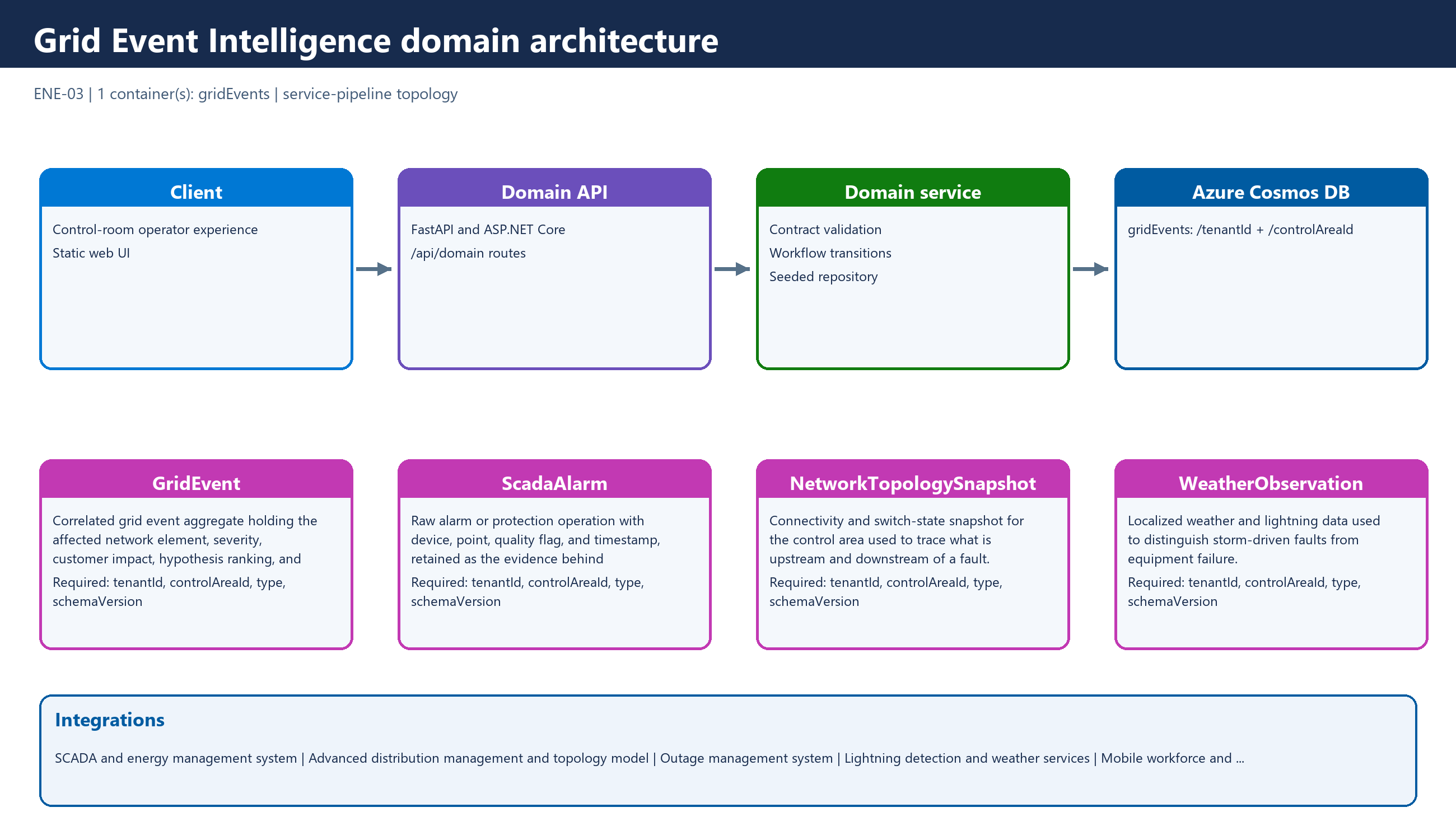
Cosmos DB data model
| Container | Hierarchical partition key | Documents | Search paths |
|---|---|---|---|
gridEvents | /tenantId, /controlAreaId | GridEvent, ScadaAlarm, NetworkTopologySnapshot, WeatherObservation, FieldWorkLogEntry, OperatorActionProposal | /activityNarrativeVectorEmbedding, /riskNotesVectorEmbedding, /activityNarrativeVector, /riskNotesVector |
Query contract
| Query | Container | Scope | Purpose |
|---|---|---|---|
| Event correlation window | gridEvents | single-partition | Read alarms and topology for the control area within the correlation window in one partition query. |
| Storm attribution check | gridEvents | single-partition | Test whether lightning or wind in the same grid cell explains the event timing. |
| Planned work overlap | gridEvents | single-partition | Rule out alarms caused by crews performing planned switching. |
| High-impact open events | gridEvents | single-partition | Prioritize unresolved events by customers affected for the operator console. |
Python and C# services route each document type to its declared container and hierarchical partition key. ETag-based writes protect mutable aggregates, while append-only records and bounded cross-partition queries preserve scale.
Azure deployment
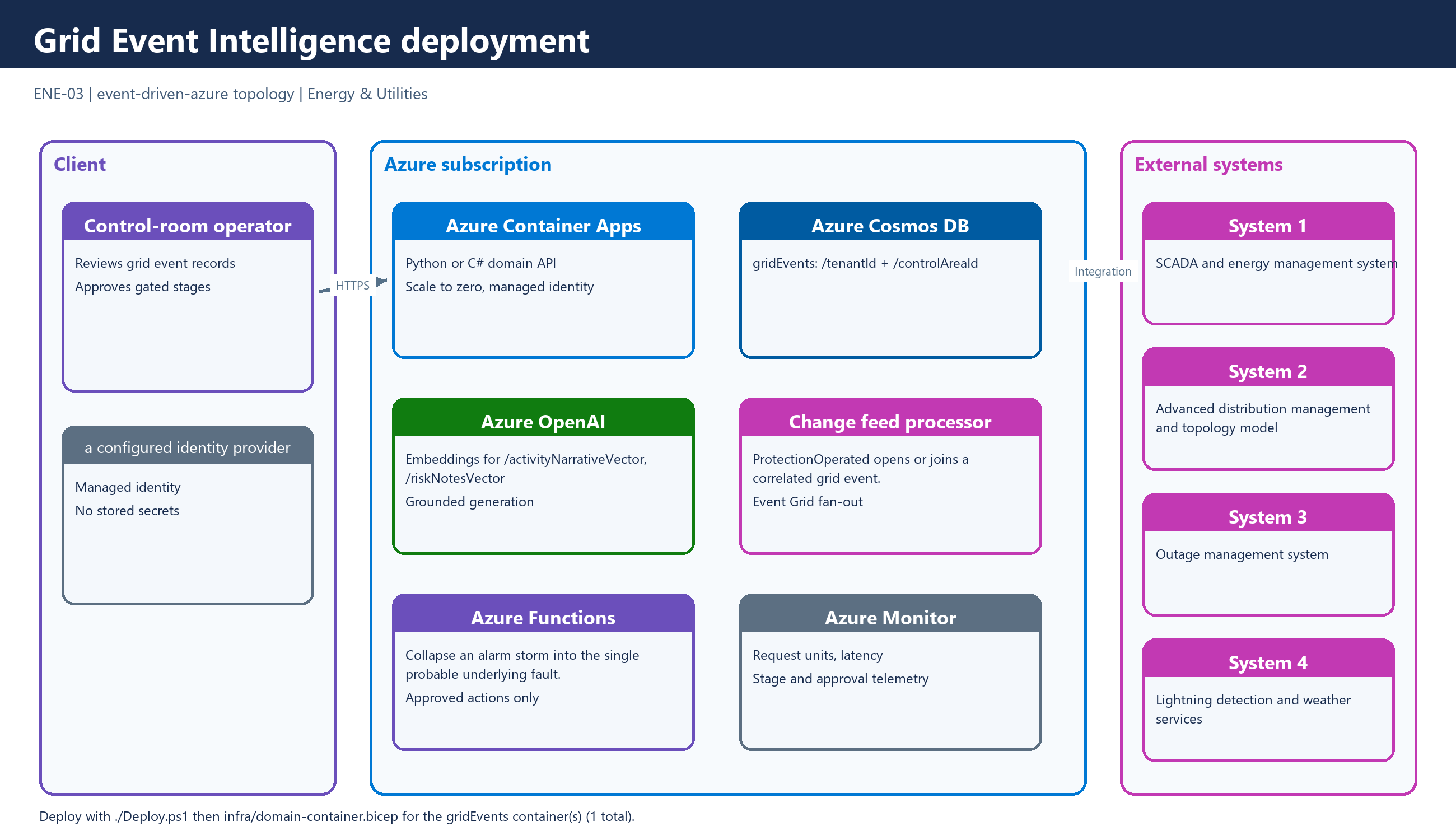
Clone the source repository, authenticate with Azure, and run:
Set-Location accelerators/energy-utilities/grid-event-intelligence
az login
./Deploy.ps1 -Runtime python -Location eastus2
Change python to csharp to deploy the .NET implementation.
Explore the implementation
- Launch signed-in demo
- Implementation article
- Domain data model
- Workflow and API contract
- Python application
- C# application
- Domain container Bicep
- Platform Bicep
- Cost and configuration
- Source repository