Mission Planning Knowledge Assistant
Outcome
Support the mission planner in building a course of action that is grounded only in approved intelligence products, current doctrine and verified resource availability, with classification handling and human authority enforced at every step of the planning cycle.
| Portfolio attribute | Value |
|---|---|
| Primary persona | Mission planner |
| Primary aggregate | MissionPlanningFolder |
| Cosmos DB containers | 3 |
| Grounding data | approved intelligence, doctrine, maps, resources |
| Development estimate | USD 60-220 monthly dev estimate |
| Runtime options | Python FastAPI and C# ASP.NET Core |
Productivity hypothesis
These measures reflect the workflow, evidence, decision boundary, and industry risk for this use case.
| Impact type | Measure | Conservative internal assumption | Customer measurement |
|---|---|---|---|
| Productivity | Task cycle time | 8-15% reduction | (baseline median task minutes - assisted median task minutes) / baseline median task minutes * 100 |
| Quality or risk | Evidence discovery time | 10-20% reduction | (baseline median evidence-search minutes - assisted median evidence-search minutes) / baseline median evidence-search minutes * 100 |
Important: Conservative internal pilot assumptions only; not public benchmarks, commitments, or expected customer results. Validate against a comparable baseline or matched control cohort with mandatory human review.
Rationale: Mission planners can assemble approved evidence faster, but mission sensitivity supports only a narrow decision-support productivity assumption.
Pilot guardrail: Use only approved intelligence, doctrine, maps, and resource information; keep operational planning human-controlled.
Customer validation plan
- Baseline the current workflow with representative users and tasks.
- Run the accelerator on the same task mix with human review retained.
- Measure task cycle time and evidence discovery time with the documented formulas.
- Replace internal assumptions with customer-observed results before a business case.
Why Azure Cosmos DB
This AI solution needs an operational data plane, not only a vector index:
- Hybrid vector and full-text retrieval combines semantic recall with exact identifiers, codes, names, and domain language.
- Hierarchical partition keys and metadata predicates keep tenant and domain boundaries in the normal query path.
- Operational JSON, source chunks, workflow and agent state, feedback, and audit records remain together for low-latency reads and governed writes.
- Change feed reacts to source and operational updates without polling.
- Autoscale throughput, configurable consistency, and multi-region distribution support variable demand and enterprise availability.
Domain workflow
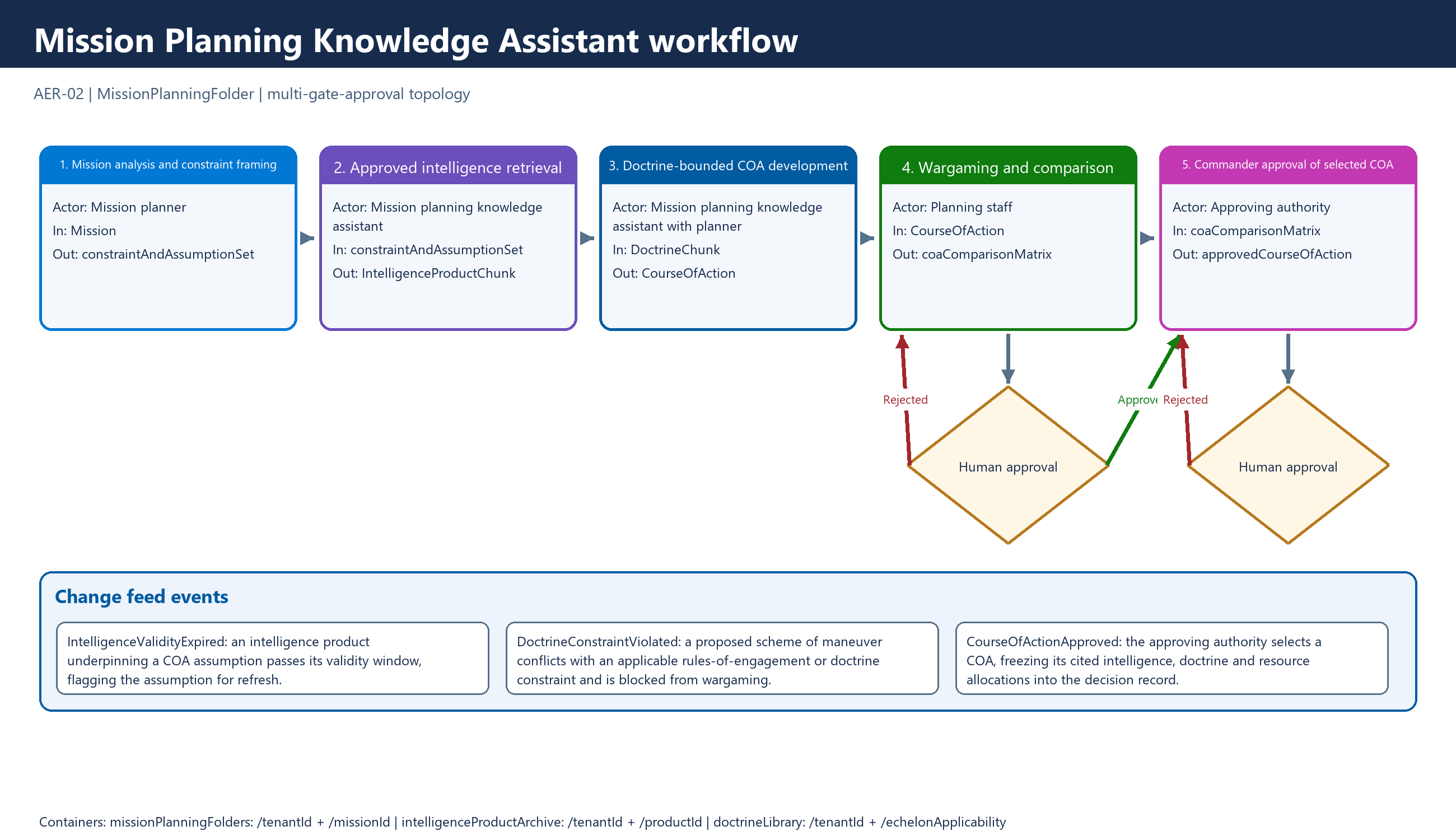
| Stage | Actor | Input → output | Approval |
|---|---|---|---|
| 1. Mission analysis and constraint framing | Mission planner | Mission → constraintAndAssumptionSet | Policy controlled |
| 2. Approved intelligence retrieval | Mission planning knowledge assistant | constraintAndAssumptionSet → IntelligenceProductChunk | Policy controlled |
| 3. Doctrine-bounded COA development | Mission planning knowledge assistant with planner | DoctrineChunk → CourseOfAction | Policy controlled |
| 4. Wargaming and comparison | Planning staff | CourseOfAction → coaComparisonMatrix | Human required |
| 5. Commander approval of selected COA | Approving authority | coaComparisonMatrix → approvedCourseOfAction | Human required |
Technical architecture
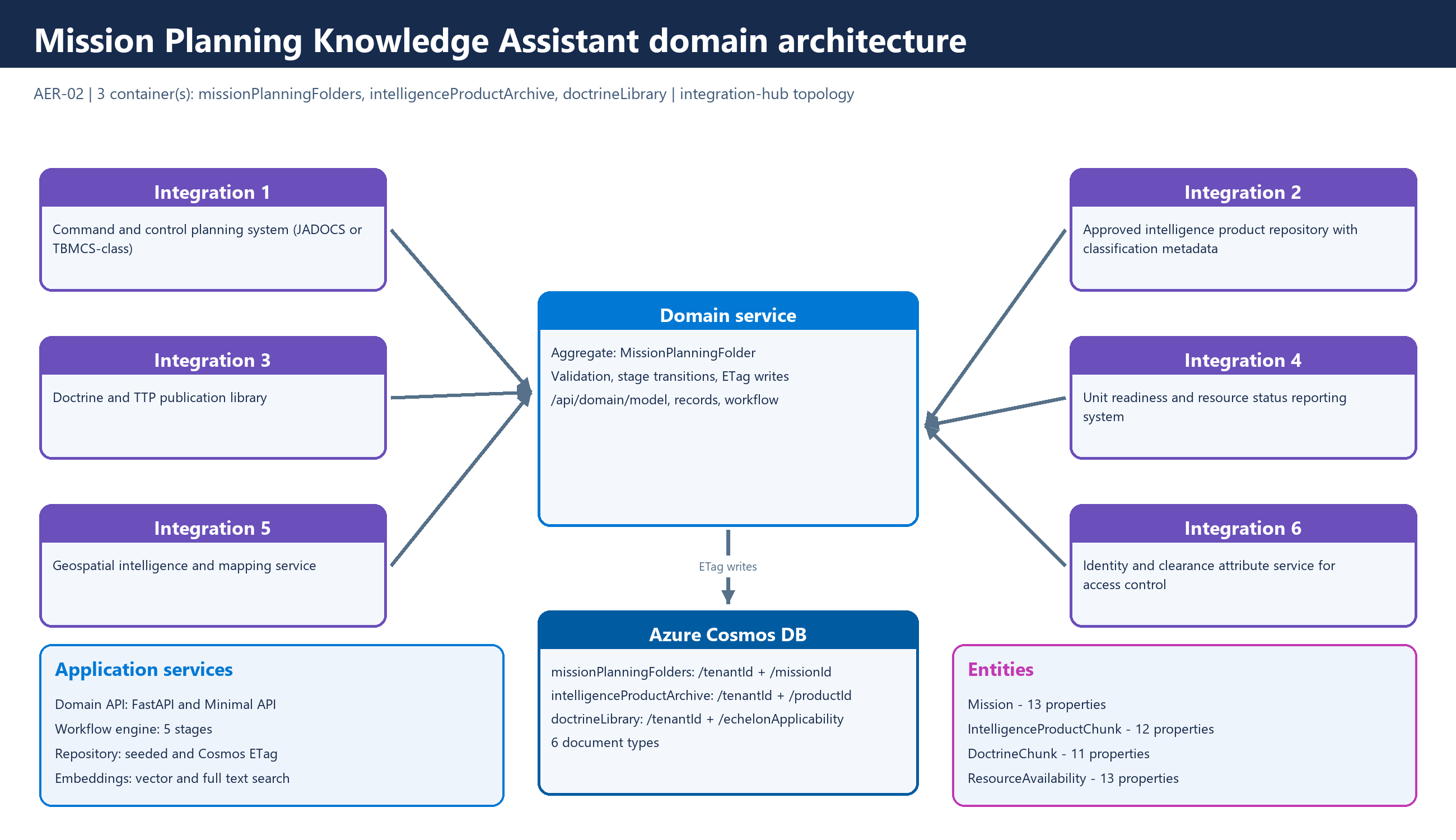
Cosmos DB data model
| Container | Hierarchical partition key | Documents | Search paths |
|---|---|---|---|
missionPlanningFolders | /tenantId, /missionId | Mission, ResourceAvailability, CourseOfAction, PlanningDecisionRecord | /coaVectorEmbedding, /coaVector |
intelligenceProductArchive | /tenantId, /productId | IntelligenceProductChunk | /chunkVectorEmbedding, /chunkVector |
doctrineLibrary | /tenantId, /echelonApplicability | DoctrineChunk | /chunkVectorEmbedding, /chunkVector |
Query contract
| Query | Container | Scope | Purpose |
|---|---|---|---|
| ClearanceScopedIntelRetrieval | intelligenceProductArchive | cross-partition-bounded | Retrieve only intelligence the requesting planner is cleared and authorized to see, still inside its validity window. Intentional cross-partition fan-out across the intelligenceProductArchive reference container, bounded by the tenant prefix, the caller clearance rank, the caller releasability tokens and the product validity window, returning only the top-ranked product chunks. |
| ApplicableDoctrineConstraints | doctrineLibrary | single-partition | Retrieve doctrine and rules-of-engagement constraints applicable to the echelon and mission type. |
| ResourcesAvailableInWindow | missionPlanningFolders | single-partition | Find platforms and crews actually available and ready across the execution window. |
| PlanningDecisionAudit | missionPlanningFolders | single-partition | Reconstruct the ordered decision trail for after-action review and authority audit. |
Python and C# services route each document type to its declared container and hierarchical partition key. ETag-based writes protect mutable aggregates, while append-only records and bounded cross-partition queries preserve scale.
Azure deployment
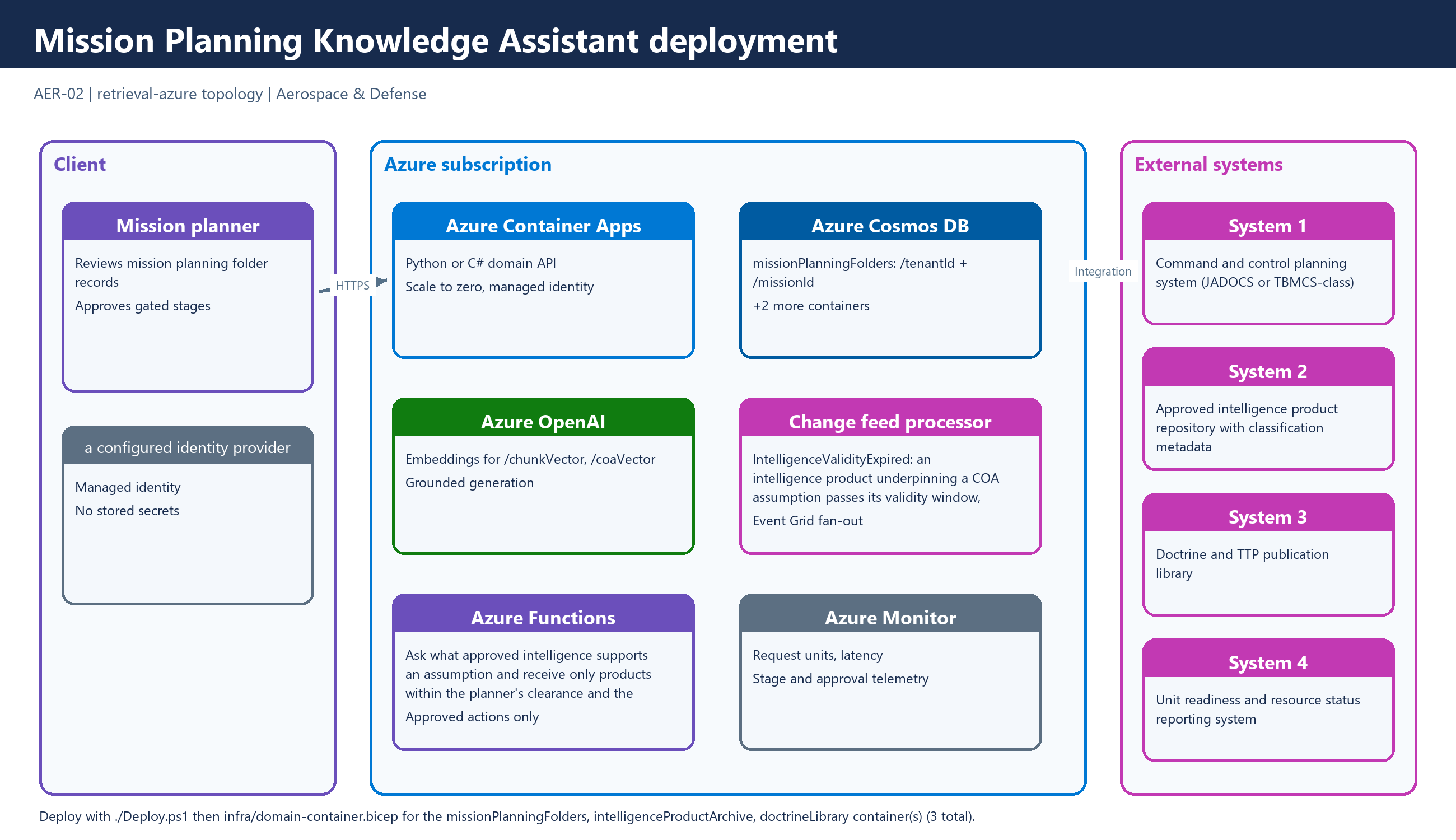
Clone the source repository, authenticate with Azure, and run:
Set-Location accelerators/aerospace-defense/mission-planning-knowledge-assistant
az login
./Deploy.ps1 -Runtime python -Location eastus2
Change python to csharp to deploy the .NET implementation.
Explore the implementation
- Launch signed-in demo
- Implementation article
- Domain data model
- Workflow and API contract
- Python application
- C# application
- Domain container Bicep
- Platform Bicep
- Cost and configuration
- Source repository